


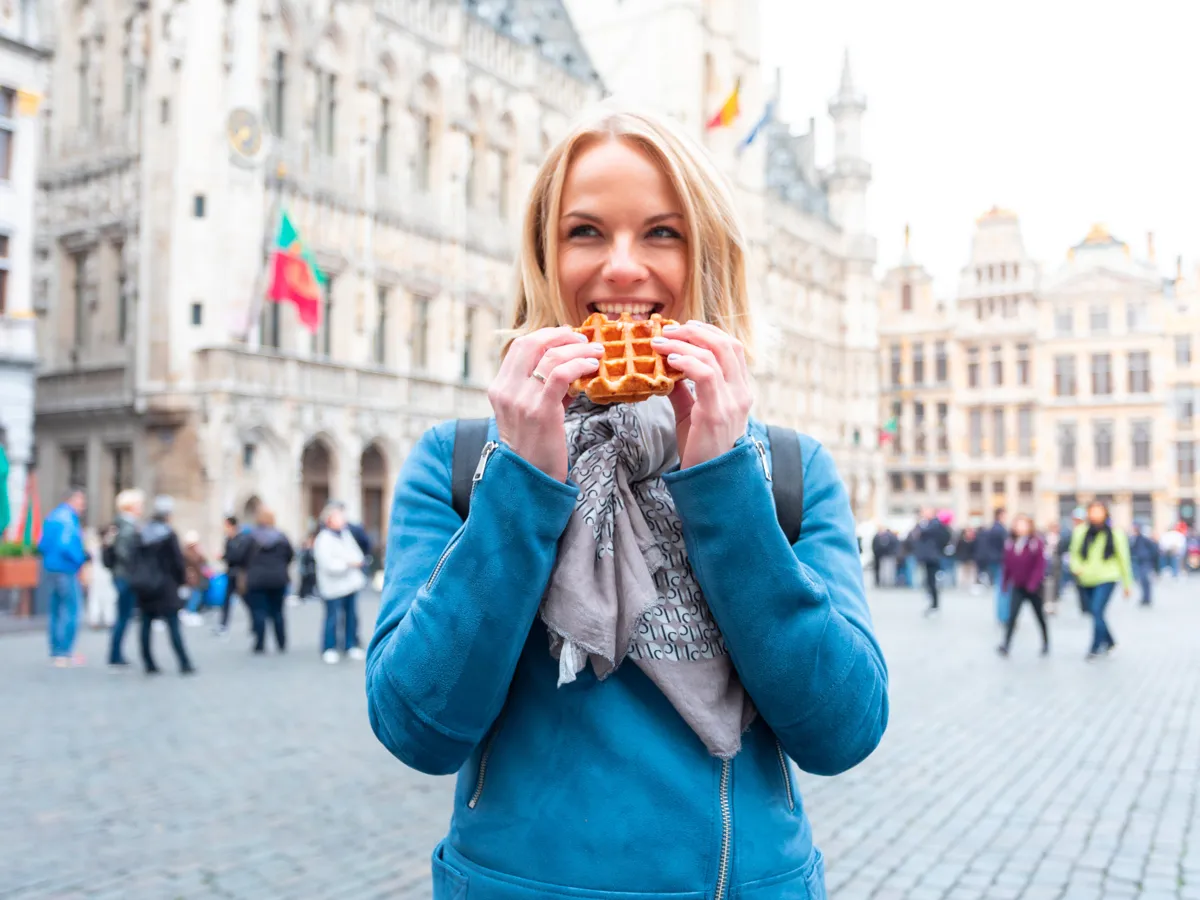
Ask for “a Belgian waffle” in Belgium and you will get a patient look.
The country has two national waffles. They are not interchangeable, they are not regional variations on a theme, and the pale, fluffy slab that turns up under strawberries at hotel brunches worldwide is only a distant relative of either. One is a dessert served on a plate. The other is a thing you eat with one hand while walking to a train.
Learning to tell them apart is, genuinely, the whole trip. What follows is a trail through four cities, built around the two waffles that matter and a short list of rules that will steer you past the sad, pre-cooked stacks sitting under heat lamps on every cathedral square in the country.
Two waffles, one country
The split runs down the middle of Belgian baking, and once you see it you cannot unsee it.
The Brussels waffle is made from a thin, leavened batter. It comes out of the iron rectangular, with clean right-angled edges, deep square pockets and a crisp shell over an interior so light it feels hollow when you pick it up. It is traditionally finished with nothing but a dusting of powdered sugar, and it is meant to be eaten within about a minute of leaving the iron, because that shell softens fast.
The Liege waffle is made from a stiff, yeasted dough closer to brioche, studded with pearl sugar. It is pressed into the iron as a rough ball, so it comes out oval and irregular, with no two the same. The pearl sugar is the whole point: it is compressed into nibs hard enough that it does not dissolve into the dough, so it survives to the iron, hits the hot plate, and caramelizes into a lacquered, faintly crackling crust. The result is dense, chewy, sweet on its own, and still good twenty minutes later in your pocket.
If you only try one, make it a Liege waffle, plain, from a window that is making them to order. It is the better introduction to the country because it asks nothing of you and nothing of the weather.
The toppings question
The waffle you have seen online – the one collapsing under whipped cream, strawberries, banana coins and a chocolate drizzle – is real. You can buy it in Belgium. Belgians largely do not.
That version has a traceable origin, and it is not European. Belgian waffles were shown to a large American audience at the 1964 New York World’s Fair, where a vendor named Maurice Vermersch sold a Brussels-style waffle with strawberries and whipped cream under the name “Bel-Gem waffle” – he had reportedly concluded that Americans would not attempt to pronounce Brussels. It sold spectacularly. The name stuck, the cream stuck, and the loaded waffle sailed back across the Atlantic as a tourist expectation.
None of which makes it bad. A good Brussels waffle with cream and real fruit is a fine thing. But it is worth knowing that when a stand near a cathedral offers you fourteen toppings, it is selling to you specifically, and the base waffle is usually the part that suffered.

The trail
Four stops, roughly west to east, all of them within about an hour of each other by train. Belgium is small enough that this is a comfortable long weekend rather than a road trip, and the national rail network makes a car actively unhelpful.
If you would rather someone else did the navigating, it is worth reading how a continental food tour actually gets put together – we asked the founder of Eating Europe Food Tours exactly that.
1. Brussels -- the waffle that carries the name
Start on the Grand Place, not because it has the best waffles but because it has the most instructive bad ones. The square itself is extraordinary – a UNESCO World Heritage site ringed by gilded guildhalls and the spire of the Town Hall – and every operator within sight of it knows you are not coming back tomorrow.
Walk two or three streets out and the quality climbs while the price drops. The Galeries Royales Saint-Hubert, a glass-roofed arcade from 1847 and one of the oldest shopping galleries in Europe, is a good hunting ground, and the Sablon district is where to go when you are ready to stop eating waffles and start eating chocolate. The praline as we know it was invented in Brussels in 1912, when Jean Neuhaus II filled a chocolate shell rather than coating something in it; the ballotin, the stiff box that keeps them from being crushed, followed a few years later. For the dining districts beyond the tourist ring, our podcast episode on Brussels is a local’s tour of where the city actually eats.
2. Ghent -- the one people skip

Ghent is the correction to Bruges. It has the same medieval waterfront, the same guild houses, the same towers – and a working university city around them instead of a permanent coach park.
Stand on St. Michael’s Bridge and three towers line up in a single view: St. Nicholas’ Church, the Belfry, and St. Bavo’s Cathedral. Below it, the Graslei and Korenlei quays face each other across the Leie with a row of stepped-gable guild houses that have been there since the city ran on grain. Ghent is also unusually good for anyone not eating meat: the city has promoted a weekly vegetarian day since 2009, and the restaurant scene absorbed the idea rather than tolerating it. Waffle stands here are aimed at students, which is another way of saying they are cheap and honest.
3. Liege -- the source
Liege is not a pretty city in the way the others are, and that is part of why the waffle here is taken seriously rather than performed. This is the home of the dough-and-pearl-sugar waffle, and it is sold plain, warm, in paper, for a couple of euros.
Go on a Sunday morning for La Batte, the market that runs for over a kilometre along the Meuse and is among the oldest and largest in the country. Eat the waffle standing in the crowd with no plate, no fork and nothing on top of it. If you have been wondering what all the fuss is about, this is the moment it resolves.
4. Bruges -- beautiful, and a test of your discipline
Bruges earns its reputation. The canals, the Markt, the Belfry and the almshouses are genuinely among the best-preserved medieval streetscapes in Europe, and you should go.
You should also assume that anything sold to you within sight of the Markt has been optimised for a visitor who will never return. Waffles here are frequently pre-made and reheated, chocolate shops sell industrial product in handsome boxes, and the difference between the two streets either side of you can be enormous. Eat early, eat away from the water, and use the rules below.
How to read a waffle stand in ten seconds
- Look for dough, not batter. A real Liege waffle stand has a tray of pale dough balls in view. No dough, no Liege waffle, whatever the sign says.
- Nothing should be pre-cooked. A stack of finished waffles under a lamp is a stack of waffles that stopped being good an hour ago. You want to wait two or three minutes.
- Order it plain the first time. If a waffle needs help, you have learned something about the stand.
- Count the toppings. Past about six, you are at a stand that competes on photographs rather than on waffles.
- Windows and vans beat restaurants. The best waffles in Belgium are sold from hole-in-the-wall counters and parked camionettes, often by someone who sells nothing else.
- Follow the queue, but check who is in it. A line of people carrying shopping bags is a good sign. A line of people carrying selfie sticks is a location, not a recommendation.
Expect to pay in the region of a couple of euros for a plain Liege waffle from a stand, and noticeably more once cream and fruit arrive. Prices on a main square are not a quality signal in either direction – they are a rent signal.
And if you would rather walk this with a guide than work the stands yourself, here is what a food tour actually involves – what it costs, how long it runs and what to ask before you book.
Do Belgians actually eat waffles for breakfast?
Generally no. A waffle in Belgium is an afternoon snack or a dessert, often eaten with coffee, and it is usually bought rather than made at home. The breakfast association is largely American, and it arrived with the frozen waffle and the hotel buffet rather than from Belgium.
What is pearl sugar, and can I substitute it?
Pearl sugar is sugar compressed into hard white nibs that resist melting. It is the defining ingredient of a Liege waffle: ordinary granulated sugar dissolves into the dough and simply makes it sweeter, whereas pearl sugar survives intact until it meets the hot iron, then caramelizes into pockets of crackly, slightly bitter crust. There is no real substitute – it is the one ingredient worth ordering specially if you want to bake these at home.
Is the “Belgian waffle” actually Belgian?
The waffles are. The name is a marketing decision. Belgian waffles were shown to American audiences at the 1958 Brussels World’s Fair and then at the 1964 New York World’s Fair, where they were sold as the “Bel-Gem waffle” with strawberries and whipped cream. That combination became what the English-speaking world means by the term, while in Belgium the waffle is still identified by its city rather than its country.
Which waffle should I try first?
A Liege waffle, plain, from a stand making them to order. It is more forgiving than a Brussels waffle, which has to be eaten within a minute or two of coming off the iron to be worth anything, and it gives you a clean baseline to judge everything else against.
How many days do I need for this trail?
Three full days is comfortable and four is relaxed. Brussels, Ghent, Bruges and Liege are all connected by frequent trains and nothing is more than about an hour and a half from anything else, so you can base yourself in one city and day-trip the rest rather than moving hotels.
The short version
Fly into Brussels, walk away from the Grand Place, take the train to Ghent for a day that costs almost nothing, get to Liege on a Sunday morning, and give Bruges an early start before the coaches land. Eat the Liege waffle plain and the Brussels waffle fast. Buy chocolate somewhere a local is also buying chocolate.
You can cross the whole country in under three hours, which means the only real constraint on this trip is how many waffles you are prepared to eat in a day. Most people revise that number upward.


